On Saturday 01 November 2025, sixty people attended the 21st Annual RISE (Research Insights in Semi-Arid Ecosystems) Symposium. You can find the program and links to the pdf version of the talks and posters presented at https://rise.santarita.arizona.edu/. The objectives of the symposium were to share recent results of scientific research in semiarid environments, with an emphasis on work conducted at the USDA-ARS Walnut Gulch Experimental Watershed (WGEW) and the University of Arizona Santa Rita Experimental Range (SRER), and to encourage collaboration among researchers and students on future research and outreach activities.
Eleven speakers covered a wide variety of topics, and some included results of work completed and on-going at WGEW or SRER. Mitch McClaran started the program with a reflection on “how we see influences what we see” by illustrating how the relationships between vegetation dynamics and precipitation on the Santa Rita depends on the number of months chosen and the life histories of the species in question.
The other talks including updates from the Santa Rita (Brett Blum) and NEON (Abe Karam) focused on opportunities for researchers to contribute to the design of the expected thinning of mesquite by the Arizona Department of Foresty and Fuel Management, and access to new NEON data and new data tools. Tristan Gould from NEON described the Airborne Observatory Network operations, data, and data availability using Google Earth Engine. Despite being remote and with a bit of a cold, Tristan provided a clear and comprehensive description of the program and many in the audience are planning to access and use that data. Shang Gao from UA School of Natural Resources and the Environment presented ongoing research on a land surface model of vegetation production and greenness on the Santa Rita showing Leaf Area Index (greenness) in relation to fire, precipitation, and grazing intensity since 1986.
A great variety of topics were covered for places other than the Santa Rita by the remaining six speakers. Meg Lapointe described the Sentinel Landscape program for managing Department of Defense lands and resources in the Southwest, with particular attention to Fort Huachuca in southeastern Arizona. Her presentation was a perfect set-up for Steve Prager’s talk about the Appleton-Whittell Research Ranch that is adjacent to Ft Huachuca. Steve introduced some new small bird tracking technology and opportunities for research and support on the 8,000-acre facilty established in 1968.
International topics were covered by Rebecca Kariuki from Arizona State University and Flavie Audoin from University of Arizona. Rebecca described land use conflicts between wildlife and expanding farmland development in Tanzania, and efforts to foster land use planning discussions in the local communities. Flavie described the upcoming United Nations “2026 International Year of Rangelands and Pastoralists” by showing a trailer for a nearly completed documentary on rangelands in North America and social media opportunities for posting content to an International Year platform including kicking a soccer ball across rangelands of the world.
Two recent authors from the University of Arizona presented in the session after lunch. Theresa Crimmins, Director of the National Phenological Network described more than a decade of data acquisition and analysis describing the change in the timing of biological events such as flowering, the impacts those changes have on people and animals, and how changing climate has influenced those phenologies. Her recent book “Phenology” by MIT Press is a crisp and accessible introduction to the field with resources for taking it further. Valerie Trouet from the University of Arizona Laboratory for Tree Ring Research provided a well-grounded introduction to “dendrochronology” as a tool for dating wood, dating fires, and recording climate variation over millennia. Her two books are “Tree Stories” by Johns Hopkins Press and “In the Circle of Ancient Trees” by Greystone Books Ltd present interesting applications of dendrochronology and personal stories about field work in adventurous places around the world.
The highlight of the Symposium was the 1.5-hour poster session where 14 presenters led a cacophony of discussions in the covered courtyard at the Integrated Learning Center. As usual, the session was full of animated and inquisitive discussions about the general message and detailed pieces of each poster. The level of interaction was very high and maybe and the fine mediterranean-themed lunch provided by UA catering fueled liveliness of the poster session.

This was the third year that we did not charge a registration fee and instead relied on donations to support the student poster awards. This year we had a glorious outpouring of donations over $1700. This amount supported $500 for the top Graduate student poster, $300 for second place, and $150 to two posters tied for third place. The top undergraduate poster received $500. If this moves you, maybe you want to use this QR to send a donation that we can apply to the awards next year.
Members of the Tierra Seca Club, which is the student chapter of the Society for Range Management once again provided coffee, juice, fruit, cheese, and baked goods for attendees before the talks began. The Club will use the donations for providing these goodies to help cover travel expenses to the national meeting of the Society for Range Management this February 2026 in Monterey, CA.
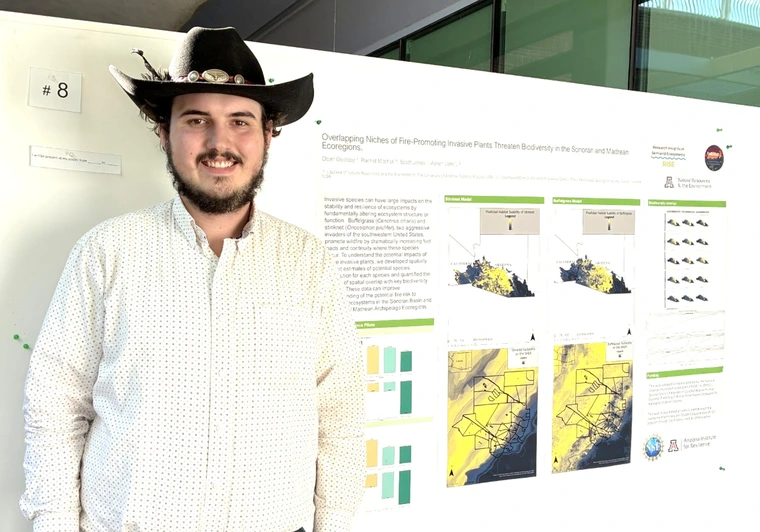
Undergraduate Student Contest Winners and Photo with Poster
Best poster at $500 went to Doan Goolsby (UA School of Natural Resources and the Environment) for the poster titled Significant Overlap in Niche of Fire-promoting Invasive Species Threatens Biodiversity of Sonoran and Madrean Archipelago Ecoregions.
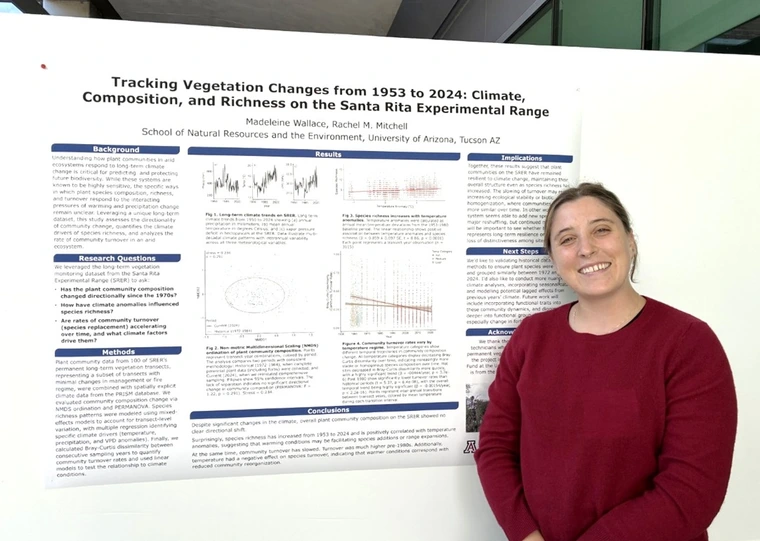
Graduate Student Contest Winners and Photos with Posters
Best poster at $500, Madeleine Wallace (UA School of Natural Resources and the Environment) for the poster titled Seventy Years of Change: Climate and Vegetation Dynamics on the Santa Rita Experimental Range.
Second place award of $300 went to Cindy Norton (UA School of Natural Resources and the Environment, UA) for the poster titled Assessing Shrub Species Distributions with Aerial Imagery Under Differing Grazing and Topographic Conditions.
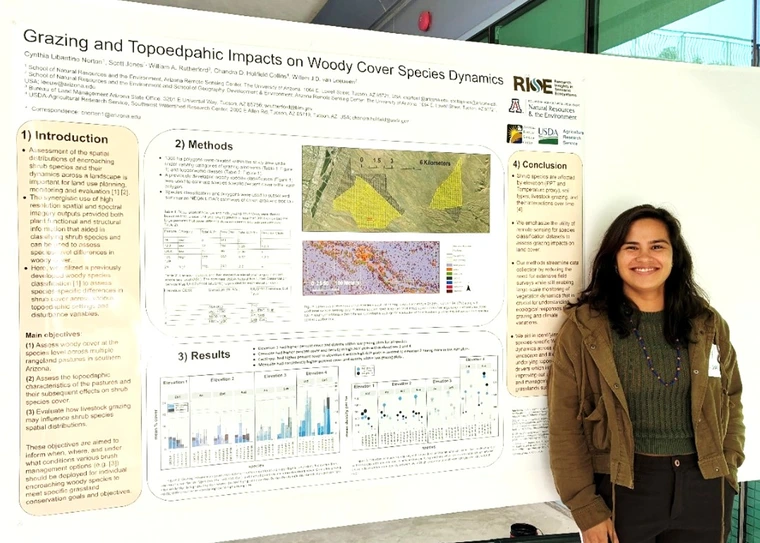
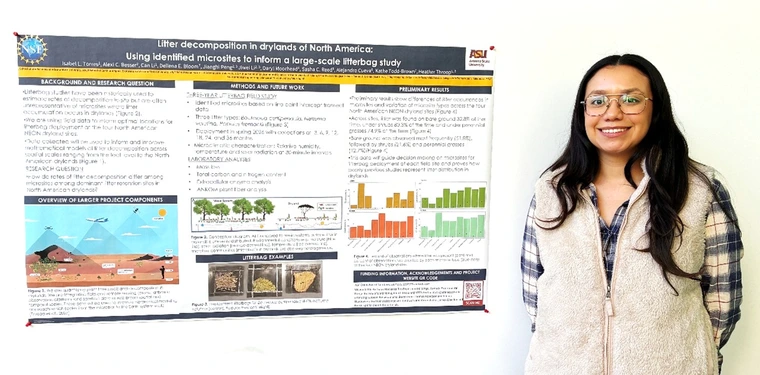
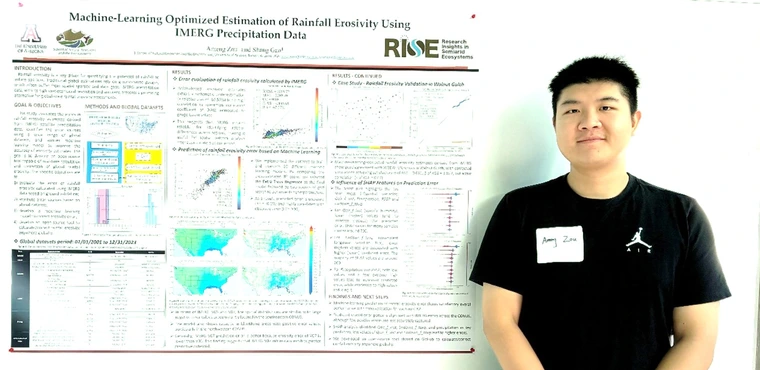
Tie for third place was between Isabel Torres (ASU School of Life Sciences) for the poster titled Litter decomposition in Drylands of North America: Using Identified Microsites to Inform a Large-scale Litterbag Study and Ameng Zou (UA School of Natural Resources and the Environment) for the poster Machine Learning-Optimized Estimation of Global Rainfall Erosivity Using IMERG Precipitation Data.